

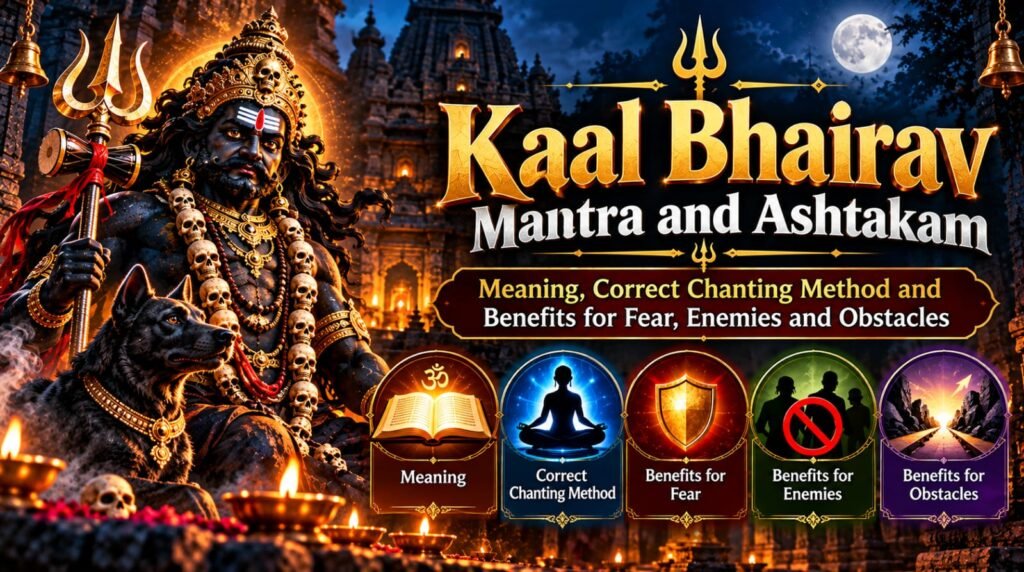
Many devotees turn to the kaal bhairav ashtakam when fear, sudden blocks or hidden hostility disturb life, especially as powerful nights like 1 December 2026 come closer.
If you feel drawn to Lord Bhairav but aren’t sure what the verses mean, how to chant at home, or which days give the deepest protection, this guide walks you through the practical basics.
Who Is Kaal Bhairav And Why His Hymn Matters
Kaal Bhairav is the fierce, protective form of Lord Shiva who guards time, directions and sacred spaces. In many temples, you’ll see him at the entrance as the kshetrapal, the protector.
Traditionally, people pray to him for courage, protection from harmful energies, help in legal or court matters, relief from sudden accidents and safety from enemies who work from the shadows.
The kalbhairav ashtak is an eight-verse hymn composed in praise of this form. It isn’t a casual text to rush through; each verse is treated as a shield for a different layer of your life.
Meaning Of Kaal Bhairav Mantra And Ashtakam
The well-known kaal bhairav mantra “Om Kaalabhairavaya Namah” is often used for simple daily jaap. For deeper sadhana, focus on the hymn that starts with “Deva raja sevyamana pavana…”, the classical eight-verse composition.
In simple language, the opening verses praise Bhairav as the lord of Kashi who destroys sins, cuts subtle fears and grants steady devotion. Later verses describe his garland of skulls, dog as vahana and his role as the controller of time and death, pointing to the truth that fear softens as rigid ego loosens.
The closing section speaks of freedom from inner enemies like greed, anger and jealousy, and protection from outer enemies who try to harm you through gossip, plotting or unseen methods. Regular recitation is said to purify old tendencies and give a sharp, alert mind.
Best Upcoming Dates For Kaal Bhairav Ashtakam Jaap
- Option 1 – Kaal Bhairav Jayanti / Bhairava Ashtami Night: Tuesday, 1 December 2026. Krishna Ashtami. Tithi begins: 30 November 2026 12:11 AM. Tithi ends: 1 December 2026 11:13 PM. Recommended late‑night jaap window (Ratri Ashtami): 30 November 2026 11:48 PM to 1 December 2026 12:44 AM. This is traditionally regarded as the most powerful night for Kaal Bhairav Ashtakam chanting for protection from fear, enemies and obstacles. Night-time Ashtami is emphasized for Bhairav worship.
- Option 2 – Monthly Kalashtami (Kaal Bhairav worship day): Sunday, 1 November 2026. Kartika Krishna Ashtami. Sacred day for focused Ashtakam jaap and vrata to remove obstacles and negativities.
- Option 3 – Previous Kalashtami In The Current Cycle: Saturday, 3 October 2026. Ashwina Krishna Ashtami. Confirms the ongoing Ashtami pattern used for Kaal Bhairav upasana in this period.
On these days, devotees prefer late evening, midnight or early morning hours, as Bhairav worship is closely linked to Ratri Ashtami. Timings are given for New Delhi and can shift slightly for other cities.
Core Kalabhairava Mantra Variants In Practice
For those who can’t manage the full hymn daily, there are shorter forms like the kalabhairava mantra “Om Kaalabhairavaya Namah,” chanted on a rudraksha mala. Many householders do this on Saturdays or Ashtami tithis, then recite the full hymn at least on special days.
Keep the pronunciation as close to the Sanskrit or your tradition’s version as you can. Consistency and faith matter more than speed or a very high count.
Correct Chanting Method For The Ashtakam At Home
The core steps are simple but need attention. A rushed, distracted practice rarely gives deep results.
First, bathe, wear clean clothes and sit facing east or north. Light a deepak with til or mustard oil, offer black sesame or mustard seeds if that’s your custom, and keep a glass of clean water near you.
Next, mentally bow to Lord Ganesha and your kula devata, then visualise Bhairav at your home’s subtle entrance, guarding you and your family. Now begin the hymn with a calm, steady pace.
Step-By-Step Simple Daily Routine
Start with three to eleven rounds of “Om Namah Shivaya” to quiet the mind. Then chant the full hymn once. Over time, many devotees slowly build up to three recitations daily, especially on Ashtami tithi.
If reading from a book or printed page, keep it clean and separate from casual material. Avoid stopping in the middle of a verse; pause between verses if needed.
Supporting Stotras And Mantras In Bhairav Sadhana
Some traditions pair the hymn in Sanskrit with a short meditation. After reciting, sit quietly for a few minutes and simply repeat Bhairav’s name mentally, letting the sound settle in the chest.
Devotees familiar with tantric upasana sometimes combine the hymn with yantra worship or related chants. For most householders, though, even a single, sincere recitation with a small deepak in the puja space is enough to start feeling safer and more centred.
You can also add a simple kaal bhairav stotra in your language if that helps the meaning touch your heart more directly.
Beej And Gayatri Mantras For Focused Sadhana
The kaal bhairav beej mantra is usually given directly by a guru, as beej sounds concentrate the deity’s energy in a very sharp form and should be handled respectfully.
Those preferring a gentler approach often chant the kaal bhairav gayatri mantra, which invokes Bhairav as the guardian of Kashi and seeker’s intelligence. A simple practice is 11 or 27 repetitions after the hymn on Ashtami days.
Benefits For Fear, Enemies And Obstacles
People don’t usually come to this sadhana out of passing curiosity. There’s often an undercurrent of fear, legal pressure, sudden losses or a sense that something “not visible” is blocking progress.
Regular recitation is believed to burn subtle fear, especially fear of travelling at night or facing difficult people. Over a few months, many devotees report a quiet confidence rather than dramatic outer events.
In case of open or hidden enemies, the practice acts like a spiritual boundary. It doesn’t give a licence to retaliate; instead it helps stop repeated harm, exposes deceit over time and gives mental clarity so you don’t keep repeating the same trusting mistakes.
For obstacles, think of the practice as cleaning an old storage room. Emotional clutter, negative thought loops and chronic delay patterns slowly loosen so you can take practical steps in work, finances or relationships.
How To Avoid Common Mistakes In Bhairav Worship
The most common mistake is treating Bhairav only as a “quick-fix” deity for enemy problems. Approaching him with fear or aggression tends to keep the same energies active in your own mind.
Don’t mix too many new rituals at once. Start with the hymn, a simple chant and consistent Ashtami practice for a few months before adding complex rituals or high counts.
Avoid intoxication or casual partying right around the time of your recitation, especially on Ashtami nights. This isn’t about moral policing; it’s about keeping your system clear for a deity linked with time, discipline and protection.
If you feel overwhelmed, reduce the count, sit quietly and take guidance from a trusted pandit or guru instead of forcing yourself to continue from fear.
Who Should Take Guidance Before Intensive Sadhana
Anyone planning high mantra counts, homa or specific remedies against black magic should take personal guidance. Online instructions can’t see your horoscope, health or mental state.
Pregnant women, those with unstable mental health and people on strong medication should keep the practice light and peaceful, focusing more on Shiva naam japa with the hymn once a day.
Conclusion
Chanting this hymn with understanding, on supportive days and in a steady, respectful routine, helps build a protective field against fear, hostility and stubborn obstacles.
Start simple, stay consistent, and if you later feel called to deeper upasana or guided puja through Live Puja Yagya, take that step with the same clarity and faith that you bring to each verse of this ancient hymn.
Frequently Asked Questions
Q1. When is Kaal Bhairav Jayanti in 2026?
Ans. For New Delhi, Kaal Bhairav Jayanti in 2026 is observed on Tuesday, 1 December 2026, with the key Ratri Ashtami jaap window from 30 November 2026 11:48 PM to 1 December 2026 12:44 AM.
Q2. How many times should I chant the Kaal Bhairav Ashtakam daily?
Ans. Many householders start with one full recitation daily and build up to three on Ashtami tithi. What matters most is regularity and a calm, focused mind, not a very high count.
Q3. Can I chant Kaal Bhairav mantras without a guru?
Ans. The hymn and simple namah mantras can be recited with devotion even without formal initiation. For beej mantras, high counts or tantric rituals, always seek guidance from a competent guru or experienced pandit.
Q4. Is it necessary to chant only at midnight for Bhairav?
Ans. Midnight during Ratri Ashtami is considered very powerful, especially on Kaal Bhairav Jayanti. Still, early morning or evening chanting done consistently is far better than forcing yourself to stay awake once in a while.
Q5. Can I keep a dog as Bhairav’s vahana and still chant the hymn?
Ans. Yes, many devotees see feeding dogs as very pleasing to Bhairav. Offering simple food to street dogs before or after your recitation is considered a practical form of seva and gratitude.
Q6. What should I do if I feel fear or “heavy” energy during chanting?
Ans. Pause, take a few deep breaths, and chant a softer Shiva mantra like “Om Namah Shivaya” until you feel settled. You can also reduce your count for a few days and consult a knowledgeable priest if the feeling continues.