

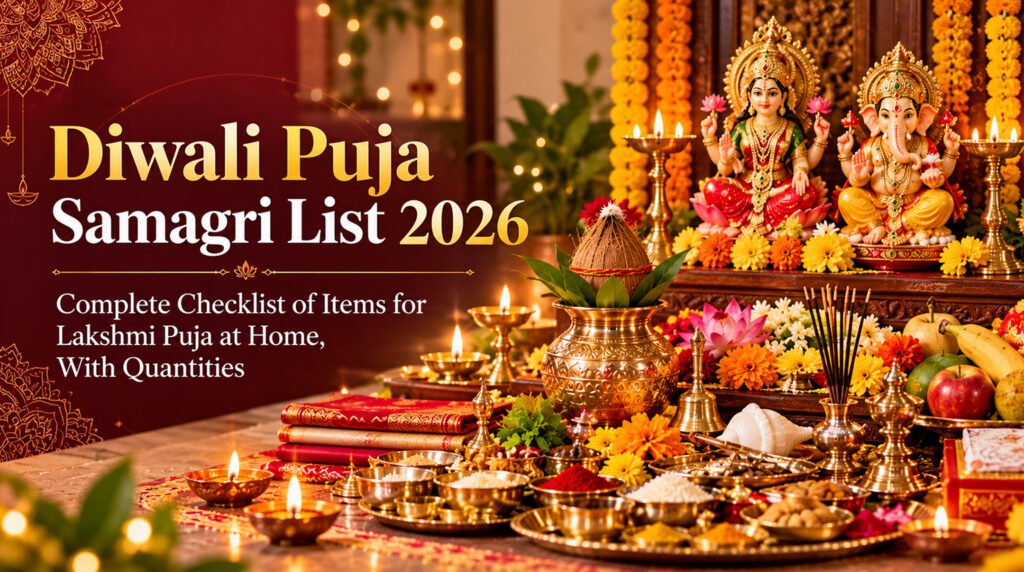
Every year, the diwali puja samagri list sneaks up on people at the last moment. On 8 November 2026, when it is finally time for Lakshmi Puja in the evening, you don’t want to be hunting for a matchbox or extra diyas.
This guide keeps your preparations simple with a clear checklist of items, practical quantities for a typical home puja, and the exact Lakshmi Puja muhurat for 2026 in New Delhi so you can plan your day without stress.
Key Lakshmi Puja Details For Diwali 2026
Before you start shopping, it helps to know exactly when Lakshmi Puja happens this year so you can schedule cleaning, cooking and setting up the altar in peace.
Diwali 2026 Date And Shubh Muhurat
- Date: Sunday, 8 November 2026
- Tithi / Nakshatra: Amavasya
- Tithi begins: 8 November 2026 5:24 PM
- Tithi ends: 9 November 2026 3:30 PM
- Lakshmi Puja Muhurat: 5:54 PM to 7:50 PM
- Pradosh Kaal: 5:33 PM to 8:10 PM
- Nishita Kaal: 11:40 PM to 12:31 AM
- Vrishabha Kaal: 5:54 PM to 7:50 PM
This window in the evening is when most families perform Lakshmi-Ganesh Puja on Kartik Amavasya. The timings above are for New Delhi; in other Indian cities, the muhurat may shift slightly, so check a local Panchang if you live elsewhere.
Core Diwali Puja Items With Suggested Quantities
This is the heart of your diwali puja items list. Quantities here suit a nuclear family of 4–6 members; for a larger joint family, increase the perishables like sweets and fruits.
Idols And Main Setup
- Murti or framed photos of Lakshmi and Ganesha – 1 each
- Chowki or low wooden stool – 1
- Red or yellow cloth for altar – 1 piece (about 1–1.5 metres)
- Small stool for the kalash – 1 (if not on main chowki)
Kalash And Water Items
- Kalash (copper, brass or steel) – 1
- Gangajal – about 50–100 ml
- Clean drinking water – 1–2 glasses
- Mango or Ashoka leaves – 5 leaves for kalash
- Coconut with husk – 1
Puja Essentials
- Haldi (turmeric) – small bowl, a few teaspoons
- Kumkum or sindoor – small bowl
- Chandan (sandalwood paste or powder) – small bowl
- Akshat (unbroken rice mixed with haldi) – small bowl
- Roli for tilak – small bowl
- Janeu (sacred thread) – 2–3 pieces
- Incense sticks (agarbatti) – 1–2 packets
- Dhoop – a few cones or sticks
- Camphor (kapoor) – small box
- Ghee for diya – 100–200 ml, depending on how many lamps you light
Deepak And Light
- Clay diyas – 21 for the main puja, plus extra for the house entrance and balcony
- Cotton wicks (batti) – 1 packet
- Matchbox or lighter – 1–2
- Steel or brass aarti thali – 1
Laxmi Pooja Samagri For The Altar
The laxmi pooja samagri focuses on items that directly touch the deities and the altar. This is where people either overbuy or forget small but important details.
For The Deities
- New red or pink cloth for Lakshmi murti – 1 small piece
- New yellow or orange cloth for Ganesha murti – 1 small piece
- Small jewellery or ornaments (optional) – as per your family tradition
- Flower garlands – 2 (one each for Lakshmi and Ganesha)
- Loose flowers (marigold, lotus if available, roses) – at least 40–50 flowers
Offerings (Naivedya)
- Assorted dry fruits – 200–250 grams
- Mishri or sugar cubes – small bowl
- Homemade or shop sweets – about 500 grams for a small family
- Paan leaves and supari – 4–5 sets
- Cloves, cardamom – a few pieces for aarti and offerings
Decoration Around The Altar
- Rangoli colours or flower petals – enough to cover the entrance and around the chowki
- Torans (bandanwar) for the door – 1–2
- Small bells, kalash stickers or Lakshmi footprints – as desired
Grouped Shopping List For Busy Households
Instead of carrying a long handwritten list to the market, use these grouped categories. Each group fits a small bag, so your shopping stays organised.
Dry Grocery And Store-Bought Items
This part of your laxmi pooja samagri list can be purchased 3–5 days before Diwali, which keeps Diwali day itself lighter.
- Haldi, kumkum, chandan, akshat ingredients
- Dhoop, incense sticks and camphor
- Wicks, ghee or oil, matchbox
- Dry fruits and mishri or sugar
- Cloves and cardamom
- New cloth pieces for the deities and altar
- Janeu, diya packs, decorative torans and stickers
Fresh Items On The Day Of Puja
Fresh flowers and fruits matter for the energy of the puja. Planning this part of your laxmi pooja items list helps avoid last-minute confusion with the fruit vendor.
- Flowers and garlands (book in advance if possible)
- Coconut, mango leaves and betel leaves
- Seasonal fruits – at least 5 varieties, 1–2 pieces each
- Fresh sweets or homemade prasad
Household And Cleaning Items
This section often gets ignored in any laxmi puja saman discussion, but a clean, well-lit home is part of the puja itself.
- New pocha or cleaning cloths
- Floor cleaner for pre-puja mopping
- Garbage bags for quick clean-up after puja
- Extra candles or battery lights in case of power cuts
Stepwise Home Lakshmi Puja Checklist
This part breaks your list of diwali pooja samagri according to the typical flow of a home puja. Keep it near the altar and tick each step mentally as you go.
1. Ghata Sthapana (Kalash Setup)
- Kalash, Gangajal, mango leaves and coconut
- Small plate of rice to place the kalash
- Kumkum and haldi for swastik and tilak
2. Avahan And Sankalp
- Roli, akshat and janeu
- Flowers and one diya already lit
- Panchamrit items if you follow abhishek (milk, curd, honey, ghee, sugar)
3. Main Puja And Aarti
- Aarti thali with ghee diya, dhoop, incense and flowers
- Naivedya plate with fruits and sweets
- Dry fruits and water in small bowls
- Bell and conch (shankh) if used in your tradition
4. Dakshina And Prasad Distribution
- Coins or small notes for offering
- Packet or small box for keeping prasad separate for guests
- Clean cloth or plate to place used items after puja
Laxmi Pooja Saman List For Different Family Setups
Not every home needs the same level of preparation. This laxmi pooja saman list is flexible depending on your space, time and how traditional your family puja is.
For Small Apartments Or First-Time Hosts
If you’re doing Lakshmi Puja yourself for the first time, focus on the basics. Idols or photos, kalash setup, a decent number of diyas and simple flowers are completely sufficient.
Keep fruits and sweets modest so you don’t feel rushed before the muhurat from 5:54 PM to 7:50 PM. A calm mind during the puja matters more than how elaborate your backdrop looks in photos.
For Joint Families And Larger Gatherings
Here, the main adjustment is quantity and seating. Double the fruits and sweets, keep extra diyas and wicks, and arrange extra aarti plates so elders and children can participate together.
Assign small responsibilities in advance: one person for rangoli and one for arranging prasad plates. Ask someone to manage diyas at the entrance and another to handle seating so the puja starts on time.
Conclusion
With a clear diwali puja samagri list, the focus on 8 November 2026 can shift from scrambling for forgotten items to actually sitting peacefully in front of the altar during the evening muhurat. Use these grouped checklists as a base, then adjust according to your family’s traditions.
If you prefer guided rituals or priest-led ceremonies, you can also explore online puja booking services offered by Live Puja Yagya and pair them with this list to keep your Diwali organised and meaningful.
Frequently Asked Questions
Q1. When is Lakshmi Puja on Diwali in 2026?
Ans. Lakshmi Puja on Diwali in 2026 falls on Sunday, 8 November 2026. For New Delhi, the main Lakshmi Puja muhurat is from 5:54 PM to 7:50 PM, within Pradosh Kaal on Kartik Amavasya.
Q2. How many diyas should I light for Lakshmi Puja at home?
Ans. There is no fixed rule, but most homes light at least 21 diyas for the main puja and entrance. You can increase the number based on space, as long as the lamps are safely placed and supervised.
Q3. Can I do Lakshmi Puja without a metal kalash?
Ans. Yes, if a traditional metal kalash is not available, a clean steel or even a sturdy glass vessel can be used. The intention, purity of water and correct placement matter more than the material.
Q4. What if I miss some small item from the puja samagri list?
Ans. If you miss a minor item like a specific flower or rangoli colour, you can still perform the puja with what you have. Focus on keeping the altar clean, lighting diyas, offering simple naivedya and chanting with faith.
Q5. Is it necessary to buy new idols of Lakshmi and Ganesha every Diwali?
Ans. No, you can continue to worship the same idols each year as long as they are intact and respectfully placed. Some families buy new idols as a tradition, but it is not a religious compulsion.
Q6. Can I perform Lakshmi Puja alone without a priest?
Ans. Many families perform Lakshmi Puja themselves by following a simple vidhi and mantras. As long as you follow the basic steps with sincerity, a priest is not mandatory for a home puja.